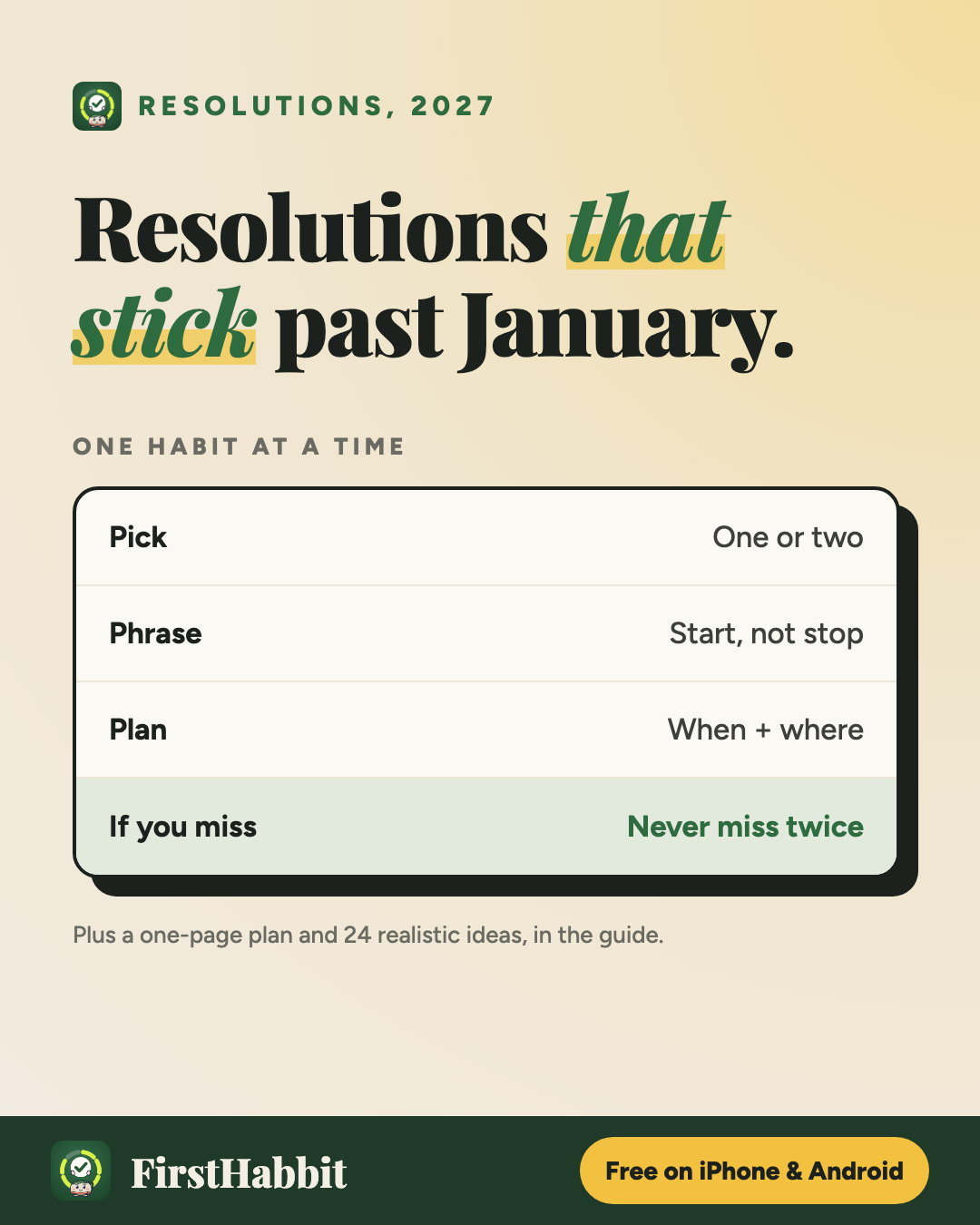
Resolutions stick when they're small, specific and scheduled. Pick one or two resolutions, not seven. Phrase each as something to start doing rather than something to stop. Shrink it into a daily or weekly habit you could do on your worst day, decide exactly when and where you'll do it, track it where you'll see it, and decide in advance what happens when you miss a day. Then give it about two months before you judge it.
The rest of this guide explains each step, what the research actually says (and what it doesn't), and how to turn a vague goal like "get healthy" into something you'll still be doing in March.
Do New Year's resolutions actually work?
You'll often see claims that "80% of resolutions fail by February". We couldn't find a study behind that number, so we won't repeat it. What the research does show is more encouraging:
- Making a resolution helps. In a study that followed people for six months, Norcross, Mrykalo and Blagys (2002) found that 46% of people who made a New Year's resolution were still succeeding at six months, compared with 4% of people who had the same goal but didn't make a resolution.
- How you phrase it matters. In a year-long experiment with over 1,000 people, Oscarsson and colleagues (2020) found that "approach" goals (start doing something) were more successful than "avoidance" goals (stop doing something): 58.9% versus 47.1% considered themselves successful after a year.
- New starts really do motivate us. Researchers Dai, Milkman and Riis (2014) called it the fresh start effect: people search for "diet", visit the gym and commit to goals more at the start of a new week, month or year. January 1 is the biggest fresh start of all, which is why it's worth using well.
So resolutions aren't pointless. Most of them just start too big and too vague.
The 9 steps
1. Pick one or two resolutions, not ten
Every new habit competes for the same limited attention and willpower. Two resolutions you keep beat seven you drop by week three. If you have a long list, rank it by "which one would make the others easier?" Better sleep, for example, makes exercise and focus easier.
2. Phrase it as something to start
Instead of "stop scrolling at night", try "read 10 pages in bed". Instead of "stop eating junk", try "have fruit with breakfast". Approach goals give you an action to take and a box to tick, and the Oscarsson study above suggests they're more likely to last.
3. Turn the outcome into a habit
"Lose weight", "save money" and "be less stressed" are outcomes. You can't do an outcome today. Ask: what would someone who has this outcome do every day or every week?
| Resolution (outcome) | Habit you can actually do |
|---|---|
| Get fit | 20-minute walk after lunch, 5 days a week |
| Read more | Read 10 pages before bed |
| Save money | Move $20 to savings every Friday |
| Sleep better | In bed by 11pm, phone charging outside the bedroom |
| Learn Spanish | One 10-minute lesson with morning coffee |
| Be less stressed | 5 minutes of slow breathing after work |
| Stay in touch | Call one friend or family member every Sunday |
4. Make it smaller than feels useful
Pick a version so small you could do it when you're tired, busy or ill. Two minutes of stretching, one page, one push-up. It feels too easy on January 2, and that's the point: the goal in the first weeks is to show up every day, not to see results. You can grow it once it's automatic.
5. Decide when and where
Vague intentions ("I'll exercise more") lose to specific plans ("On Monday, Wednesday and Friday at 7am, I'll walk the park loop"). Psychologists call these implementation intentions: "When situation X happens, I will do Y." A meta-analysis of 94 studies by Gollwitzer and Sheeran (2006) found they had a medium-to-large effect on reaching goals.
The easiest version is to attach the new habit to something you already do every day, known as habit stacking: "After I pour my coffee, I'll do my Spanish lesson."
6. Make it easy to start and hard to skip
Set things up the night before. Running shoes by the door. Book on your pillow. Savings transfer on autopay. Remove friction from the habit you want, and add friction to the one you don't (log out of the app, keep snacks out of sight). Our guide to breaking a bad habit covers the "add friction" side in more detail.
7. Track it where you'll see it
Recording your progress works. A large review by Harkin and colleagues (2016), covering 138 studies, found that monitoring progress helped people reach their goals, and the effect was stronger when progress was physically recorded. A tick on a paper calendar or a streak in an app does the job. Keep it somewhere you look every day: your fridge, your home screen, your daily to-do list.
8. Plan for missed days before they happen
You will miss a day. Everyone does. Decide now what you'll do when it happens: never miss twice, and come back with the smallest possible version the next day. In the best-known study on habit formation, Lally and colleagues (2010) found that missing a single day did not materially affect how a habit formed. Missing a day isn't the problem; quitting after it is. We wrote a whole guide on getting back on track after a broken streak.
9. Give it two months, then review
In the same Lally study, it took a median of 66 days for a daily behaviour to feel automatic, with a huge range from 18 to 254 days depending on the person and the habit. So don't judge your resolution in the second week of January. Put a review on your calendar for the start of March and ask: is this working, does it need to be smaller, or is it time to grow it? A short weekly review every Sunday helps you catch problems earlier.
Realistic New Year's resolution ideas for 2027
All of these are small enough to start on January 1 and track as a yes/no habit:
- Health: drink a glass of water after waking; walk 10 minutes after lunch; eat one portion of vegetables with dinner.
- Fitness: 10 push-ups or squats before the shower; stretch for 5 minutes before bed; a longer walk every Saturday.
- Sleep: the same wake-up time every day; no caffeine after 2pm; phone out of the bedroom. Our evening routine checklist has more.
- Mind: write one line in a journal at night; 5 minutes of quiet breathing; one screen-free hour on Sundays.
- Money: a weekly money check every Friday; move a fixed amount to savings on payday; wait 48 hours before non-essential purchases over $50.
- Learning: read 10 pages a day; one language lesson a day; one online course module every week.
- Relationships: call one person every Sunday; a phone-free dinner three nights a week; send one thank-you message a week.
- Work and focus: write tomorrow's top three tasks before you finish work; do the hardest task first; a 30-minute weekly review.
Want more? Our list of 100 habit tracker ideas is sorted by goal.
A one-page resolution plan you can copy
Fill this in for each resolution (one or two, remember):
- Resolution: Read more
- Daily habit: Read 10 pages
- Tiny version for bad days: Read 1 page
- When and where: In bed, right after I plug in my phone across the room
- Make it easy: Book on my pillow every morning
- How I'll track it: Daily routine with a 10:15pm reminder
- If I miss a day: Read 1 page the next night. Never miss twice.
- Review date: March 1
How FirstHabbit helps
FirstHabbit is a to-do list and habit tracker that makes these steps easy to keep:
- Routines with streaks. Each resolution becomes a daily or weekly routine with a streak, in the same Today list as your to-dos, so you see it every time you plan your day.
- Quick-add in plain English. Type "Read 10 pages every day 10pm" and it's a daily routine with a reminder.
- Reminders at the time you chose, with Mark done right in the notification.
- Forgiving streaks. Streak freezes and a "life happened" pause mean one missed day doesn't wipe out three weeks of progress.
- A home screen widget that keeps your streaks in view.
Start free on iPhone or Android with 4 to-dos and 4 habits, plus streaks and reminders. Pro unlocks unlimited everything.
Frequently asked questions
How do you keep a New Year's resolution?
Choose one or two, phrase them as something to start, turn each into a small daily or weekly habit, decide exactly when and where you'll do it, track it somewhere you look every day, and plan in advance to never miss two days in a row.
What percentage of New Year's resolutions fail?
There's no reliable single figure; the popular "80% fail by February" claim doesn't trace back to a study. One study by Norcross and colleagues (2002) found 46% of resolvers were still succeeding after six months, versus 4% of people who wanted to change but didn't make a resolution.
What are good New Year's resolutions that are realistic?
Small, trackable habits: drink water after waking, walk 10 minutes a day, read 10 pages before bed, keep the same wake-up time, save a fixed amount every payday, or call one friend every week.
How long does it take for a resolution to become a habit?
In Lally and colleagues' 2010 study, it took a median of 66 days for a daily behaviour to become automatic, ranging from 18 to 254 days. Plan for around two months, not 21 days.
Should I start my resolution on January 1?
January 1 is a useful fresh start, but any Monday or first of the month works too. If you miss the start, begin on the next one instead of waiting a whole year.
Ready to build better habits?
Download FirstHabbit free: calm to-dos and daily routines with streaks and gentle reminders.
Related Articles

How to Build a Habit That Sticks: A 7-Step Guide (2026)
Broke Your Streak? How to Get Back on Track After Missing a Habit (2026)
Habit Tracker Ideas: 100 Habits to Track, Sorted by Goal (2026)
