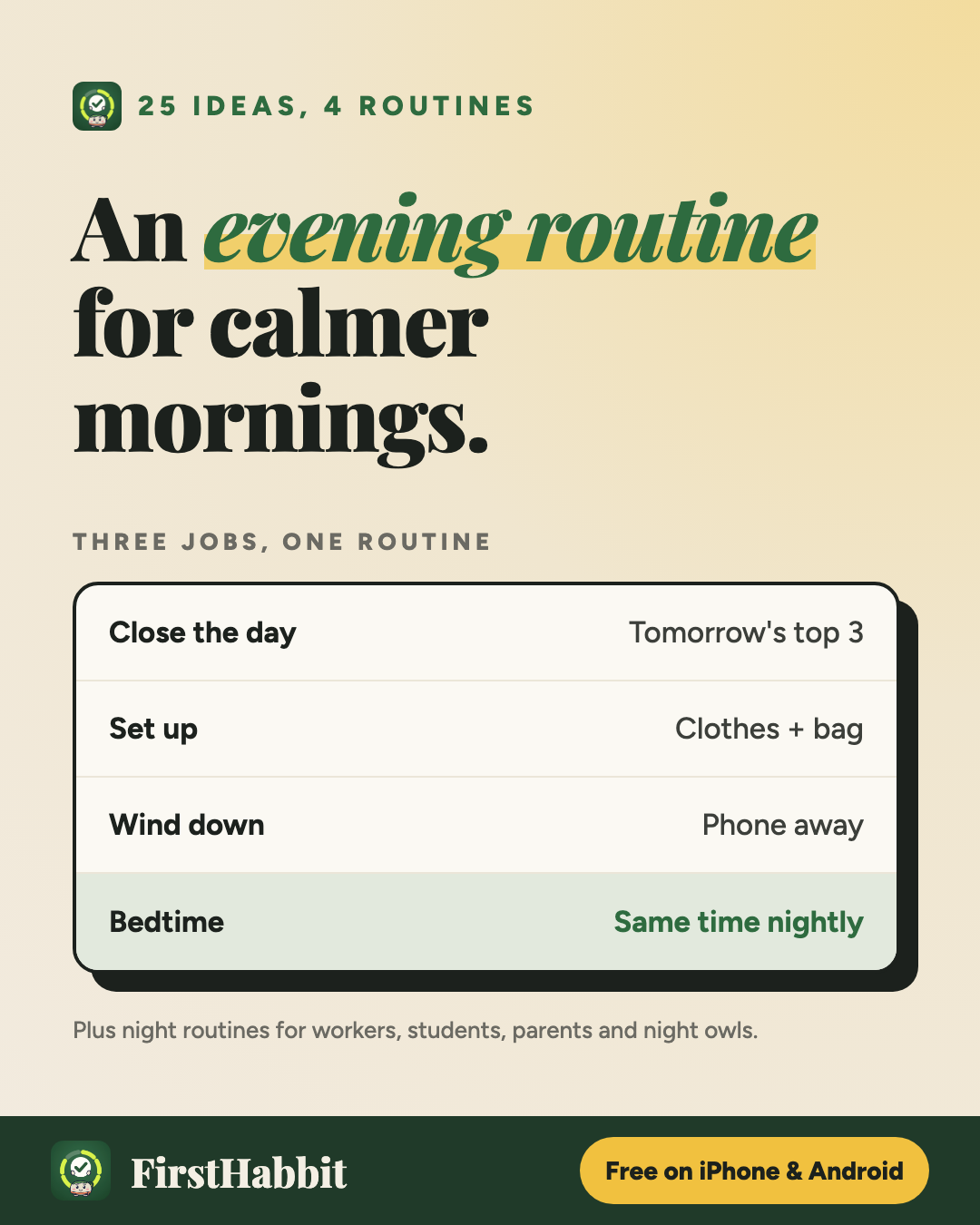
A good evening routine does three jobs: it closes the day, sets up tomorrow, and helps you wind down for sleep. Keep it short (20 to 45 minutes), start it at the same time each night, and pick 3 to 5 steps from the checklist below, for example: write tomorrow's top three tasks, a 10-minute tidy, lay out clothes, phone on charge outside the bedroom, read in bed. The most important part isn't any single step. It's going to bed and getting up at roughly the same time every day.
Below are 25 evening routine ideas grouped by job, four ready-made night routines to copy, and how to make one stick.
Why an evening routine matters
Most morning problems start the night before: a late night, a messy kitchen, no plan for the day. An evening routine fixes that while you still have time to act.
Sleep is the biggest piece. The CDC says adults aged 18 to 60 need 7 or more hours of sleep a night, and a joint consensus statement from the American Academy of Sleep Medicine and the Sleep Research Society reached the same 7-hour minimum. A routine that starts at the same time each night makes it much easier to actually get to bed on time.
The evening routine checklist: 25 ideas
Pick a few from each group, not all 25.
Close the day
- Write tomorrow's top three tasks. It takes two minutes and stops you lying awake rehearsing them (more on the research below).
- Review today's to-do list. Tick off what's done, move what isn't to a specific day.
- Shut down work. Close the laptop, write where you left off, and turn off work notifications.
- Check tomorrow's calendar so there are no early-meeting surprises.
- Write one line in a journal: one good thing, or one thing you learned.
Set up tomorrow
- Lay out clothes for the morning.
- Pack your bag: keys, wallet, laptop, gym kit, kids' school things.
- Prepare breakfast or lunch, or at least decide what it will be.
- 10-minute tidy: kitchen counters, sink, the "drop zone" by the door.
- Fill a glass of water for the morning.
- Set out anything for your morning habit: running shoes, book, yoga mat. Our morning routine checklist pairs well with this.
Look after yourself
- Light stretching for 5 to 10 minutes.
- A short walk after dinner.
- Skincare and teeth, done earlier rather than when you're already exhausted.
- Take any evening medication or supplements (a routine with a reminder helps here).
- A warm shower or bath.
- Call or message someone you care about.
Wind down for sleep
- Set a "screens off" time, or at least move the phone out of reach of the bed.
- Charge your phone outside the bedroom and use a cheap alarm clock instead.
- Dim the lights in the last hour.
- Read a paper book or an e-reader without a bright screen.
- Cut off caffeine early. In one study by Drake and colleagues (2013), a large dose of caffeine taken even six hours before bed cut total sleep by more than an hour. A 2pm cut-off is a good rule of thumb.
- Keep the bedroom cool, dark and quiet.
- Do a few minutes of slow breathing or a short body scan.
- Go to bed at the same time, including most weekends.
Write tomorrow's to-do list before bed
This one deserves its own section because it's backed by a neat experiment. Scullin and colleagues (2018) had young adults spend five minutes before bed either writing a to-do list for the coming days or writing about tasks they'd already completed. In the sleep lab, the to-do list group fell asleep faster, and the more specific their lists, the faster they fell asleep.
It fits with earlier research by Masicampo and Baumeister (2011) showing that making a specific plan for an unfinished goal reduces how much it intrudes on your thoughts. Write it down, give it a time, and your brain can let it go until morning. Our guide to planning your day in 10 minutes shows a simple format.
4 evening routines you can copy
1. The 9-to-5 worker (45 minutes)
| Time | Step |
|---|---|
| 6:00 pm | Shut down work: write where you left off, close the laptop |
| After dinner | 15-minute walk |
| 9:30 pm | 10-minute kitchen tidy, prep tomorrow's lunch |
| 9:45 pm | Write tomorrow's top three tasks |
| 10:00 pm | Phone on charge in the kitchen |
| 10:00 pm | Shower, teeth, skincare |
| 10:15 pm | Read in bed, lights out by 10:45 |
2. The student (30 minutes)
| Time | Step |
|---|---|
| 9:30 pm | Pack bag for tomorrow, check timetable and deadlines |
| 9:40 pm | Write tomorrow's top three study tasks |
| 9:45 pm | 5-minute flashcard review of today's material |
| 10:00 pm | Phone on silent, out of reach |
| 10:00 pm | Shower and teeth |
| 10:15 pm | Read something that isn't for class |
More study habits are in our student habit tracking guide.
3. The parent with young kids (25 minutes, after kids are asleep)
| Time | Step |
|---|---|
| After bedtime | 10-minute reset of the kitchen and living room |
| Pack school bags and lay out clothes | |
| Check tomorrow's family calendar and who's doing what | |
| Write three to-dos for tomorrow | |
| 10 minutes for yourself: a book, a bath, a call with a friend | |
| Bed at a set time, even if the house isn't perfect |
4. The night owl (35 minutes, later start)
| Time | Step |
|---|---|
| 11:30 pm | Write tomorrow's top three tasks and check the calendar |
| 11:40 pm | Stretch for 10 minutes |
| 11:50 pm | Dim the lights, phone to the charger outside the room |
| 12:00 am | Shower and teeth |
| 12:15 am | Read until sleepy, lights out by 12:45 am |
Night owls don't need to become morning people. The aim is still a consistent bedtime and wake time that gives you 7+ hours. More full-day schedules are in our daily routine templates.
How to make your evening routine stick
- Start with three steps. You can add more later. A 10-step routine on night one is a routine abandoned by night four.
- Anchor it to something that already happens every night, like finishing dinner or the kids' bedtime. That's habit stacking: "After I load the dishwasher, I'll write tomorrow's top three."
- Set a reminder for the first step only. Once you've started, the rest follow.
- Make the phone step easy. Put the charger in the kitchen so "phone out of the bedroom" happens on its own.
- Have a tiny version for late nights: just teeth, tomorrow's top three, and phone on the charger.
- Track it. A streak for "evening routine" or for the one step you care about most keeps it visible. If you miss a night, get back on track the next day without starting over.
Evening routine checklist (copy and paste)
EVENING ROUTINE  —  start at: ______

[ ] Shut down work / review today's list
[ ] Write tomorrow's top 3 tasks
[ ] 10-minute tidy
[ ] Lay out clothes, pack bag
[ ] Phone on charge outside the bedroom
[ ] Teeth, skincare, medication
[ ] Read or stretch, lights dim
[ ] Lights out by: ______
How FirstHabbit helps
FirstHabbit is a to-do list and habit tracker that fits an evening routine well:
- This Evening is a built-in section of Today for after-work tasks, so your evening jobs don't clutter the morning.
- Routines with reminders: type "Write tomorrow's top 3 every day 9:45pm" and it's a daily routine with a reminder and a streak.
- An evening review you can turn on for a nightly wrap-up of what's done and what moves to tomorrow.
- Quick-add for tomorrow: "Call the dentist tomorrow 10am" sets the day and the reminder in one line, so your bedtime to-do list takes a minute.
- Forgiving streaks with freezes and a "life happened" pause, so one late night doesn't reset everything.
Start free on iPhone or Android with 4 to-dos and 4 habits, plus streaks and reminders. Pro unlocks unlimited everything.
Frequently asked questions
What should be in an evening routine?
Something to close the day (review your to-do list and write tomorrow's top three tasks), something to set up tomorrow (clothes, bag, a quick tidy) and something to wind down (phone away, dim lights, reading or stretching), finished at a consistent bedtime.
How long should an evening routine be?
Twenty to 45 minutes is plenty for most people. Start with three steps and only add more once those feel automatic.
What time should I start my evening routine?
Work back from your bedtime. If you need to be asleep by 11pm to get 7 or more hours before your alarm, start the routine around 10 to 10:15pm.
Does writing a to-do list before bed help you sleep?
In a 2018 sleep-lab study by Scullin and colleagues, people who spent five minutes writing a to-do list for the coming days fell asleep faster than people who wrote about tasks they'd already completed. More specific lists were linked to falling asleep faster.
What's the difference between an evening routine and a bedtime routine?
A bedtime routine is the last 15 to 30 minutes before sleep (teeth, reading, lights out). An evening routine is broader and also includes closing the day and preparing for tomorrow.
Ready to build better habits?
Download FirstHabbit free: calm to-dos and daily routines with streaks and gentle reminders.
Related Articles
Morning Routine Checklist: 20 Ideas + 4 Ready-Made Routines You Can Copy (2026)

Daily Routine Templates: 7 Schedules You Can Copy Today (2026)
How to Do a Weekly Review in 30 Minutes: Checklist + Template (2026)
