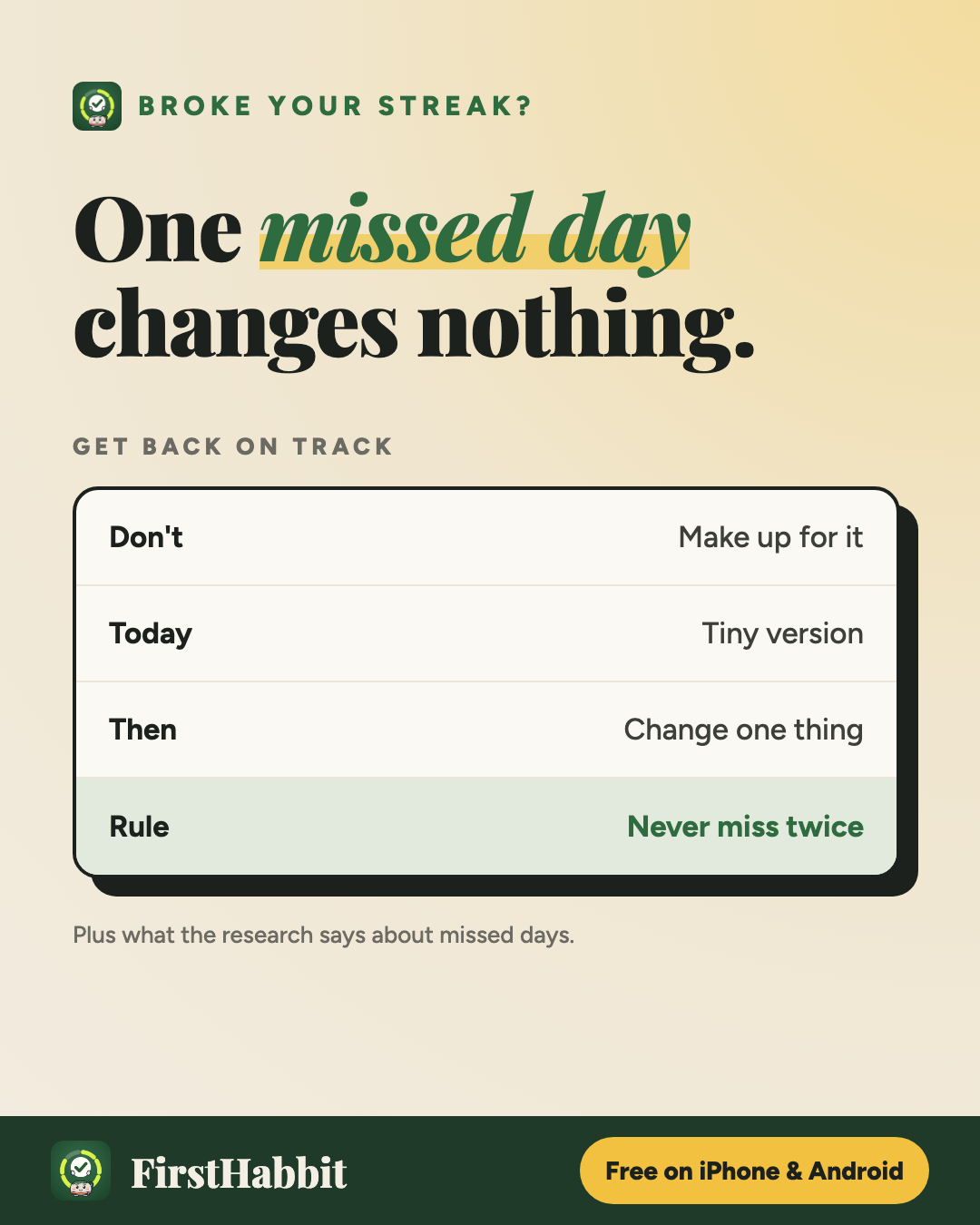
Missing one day doesn't undo a habit. Quitting after it does. In the best-known study on how habits form, missing a single day had no real effect on the habit in the long run. So when you break a streak: don't try to make up for it, do the smallest version of the habit today, figure out what got in the way and change one thing, and follow the rule "never miss twice". If life has got properly in the way (illness, travel, a new baby), pause on purpose instead of failing by accident.
Below is what the research says, why a broken streak feels worse than it is, and a six-step plan to restart today.
What actually happens when you miss a day
In 2010, Phillippa Lally and colleagues at University College London asked 96 people to pick a new daily habit (like eating fruit with lunch or a short run before dinner) and report every day for 12 weeks how automatic it felt.
Two findings matter here:
- Habits take a while. It took a median of 66 days for a habit to reach its peak automaticity, with a range from 18 to 254 days. Our article on the 21-day myth explains this in more detail.
- A single miss didn't matter much. Missing one opportunity to perform the behaviour did not materially affect the habit-forming process. People who missed a day and carried on ended up in much the same place.
In other words, a habit is built by the overall pattern of repetition, not by an unbroken chain. The streak is a tool for motivation, not a measure of the habit itself.
Why a broken streak feels so bad
If one miss is harmless, why does it feel like a disaster?
- All-or-nothing thinking. Dieting researchers Janet Polivy and C. Peter Herman described what's often called the "what-the-hell effect": once people feel they've broken a rule, they tend to abandon it completely ("I've already ruined today, so..."). A broken streak triggers the same thinking: "I've lost my 40 days, what's the point?"
- Losing the number. A streak counter turns weeks of effort into a single number, and seeing it drop to zero feels like losing all that effort, even though the habit is still mostly there.
- Self-criticism. Beating yourself up feels responsible, but it tends to make the next attempt harder, not easier.
Research on self-compassion suggests a kinder response works better. In a study by Adams and Leary (2007), people on diets who were encouraged to go easy on themselves after eating a doughnut ate less in a later taste test than those who weren't. The lesson for habits: treat the miss as information, not a verdict.
How to get back on track: a 6-step plan
1. Don't make up for it
Doing two workouts tomorrow or reading 40 pages to "catch up" turns a small habit into a big one, and big habits are easier to skip. Just do today's normal habit, or less.
2. Do the tiny version today
Today's only job is to show up. Two minutes counts. One push-up, one page, one minute of meditation, one glass of water. The goal is to make the restart so easy you can't say no.
3. Find out what got in the way
Be curious, not critical. The cause is usually one of these:
| What happened | Try this |
|---|---|
| Forgot | A reminder at a specific time, or stack it onto something you never skip |
| Too tired | Move it earlier in the day, or shrink it |
| Too big | Cut it in half, or set a "tiny version" that still counts |
| Routine changed (travel, new job, guests) | Pick a new anchor that exists in the new routine |
| Didn't really want to | Reconnect it to why you started, or swap it for a habit you'd enjoy more |
| Ill or exhausted | Rest. Pause the habit on purpose (see step 6) |
4. Change one thing
Make one small change from the table above, not five. A new time, a smaller target, a reminder, or a better spot for the cue (shoes by the bed, book on the pillow).
5. Never miss twice
The phrase was made popular by James Clear in Atomic Habits (here's our summary of the book). One miss is an accident; two in a row is the start of a new pattern. Whatever happens, do the tiny version tomorrow.
6. Pause on purpose when life gets in the way
There's a difference between a habit you dropped and a habit you paused. If you know you'll be ill, travelling or in a busy season, decide in advance: "I'm pausing my gym habit for two weeks and restarting on the 15th." A planned pause keeps the habit's identity intact. It also helps to restart on a fresh start date, like a Monday or the first of the month; researchers Dai, Milkman and Riis (2014) found people are more motivated to pursue goals at these temporal landmarks.
What if you've missed a week, or a month?
The same plan works, with two changes:
- Restart smaller than before. If you were running 5k, start with a 10-minute walk-run. Your habit is probably still partly there; your fitness or confidence may need a few days.
- Restart only one habit first. If several habits fell off at once, bring back the one that makes the others easier (often sleep or a planning habit), and add the rest one at a time.
A short weekly review every Sunday helps you notice a slipping habit after one or two misses rather than four weeks.
Should you even track streaks?
Streaks are motivating for many people: watching a number grow gives you a reason to show up on a lazy day. But a streak that resets to zero after a single miss can backfire by triggering the all-or-nothing reaction above.
The best setups make streaks forgiving: they allow a planned rest day, a "freeze" for the odd miss, or a pause for holidays, and they also show your overall consistency (for example "5 of 7 this week"), which better reflects how habits actually form. If your current tracker punishes every miss, consider one that doesn't. Our comparison of habit tracker apps covers the options.
How FirstHabbit helps
FirstHabbit is a to-do list and habit tracker designed around the idea that one missed day shouldn't wipe out your progress:
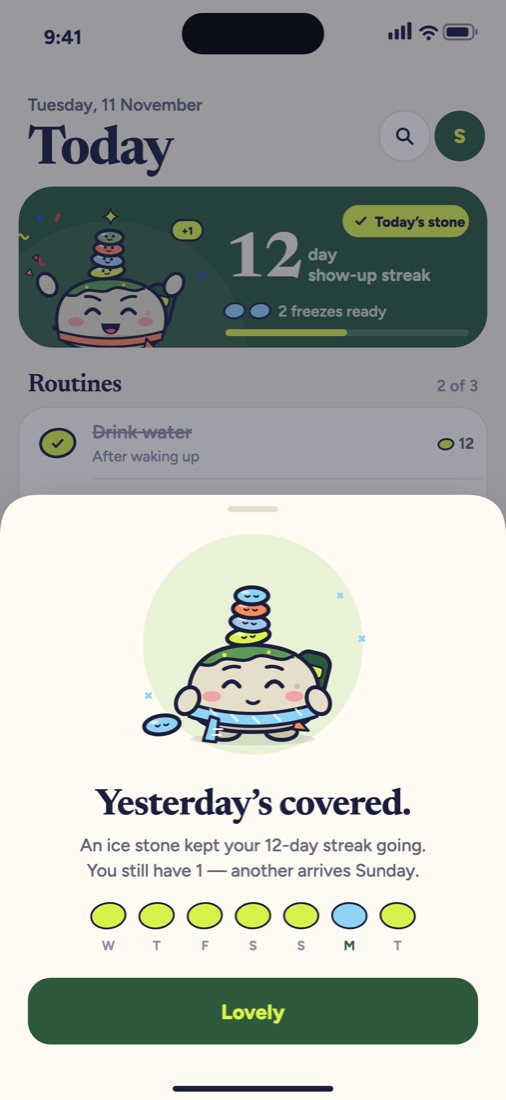
- Streak freezes cover the odd missed day automatically, and you can see how many you have left.
- One free streak repair a month for the day you genuinely forgot.
- A 14-day "life happened" pause for illness, travel or a rough patch, so you can pause on purpose.
- A week of dots for each routine, so you see your overall consistency, not just the number.
- Reminders at the time you choose, with Mark done in the notification, to fix the "forgot" problem.
- Your routines and to-dos in one Today list, so the habit is part of your day, not another app to open.
Start free on iPhone or Android with 4 to-dos and 4 habits, plus streaks and reminders. Pro unlocks unlimited everything.
Frequently asked questions
Does missing one day ruin a habit?
No. In Lally and colleagues' 2010 study of habit formation, missing a single opportunity did not materially affect how the habit formed. What matters is getting back to it the next day.
What does "never miss twice" mean?
It's a rule popularised by James Clear: you'll sometimes miss a habit, but never let it happen two days in a row. One miss is an accident; two in a row starts a new pattern.
How do I get motivated again after breaking a streak?
Don't wait for motivation. Do the smallest possible version of the habit today, such as one page or two minutes, and change one thing that caused the miss, like the time or a reminder. Motivation usually returns once you've started again.
Should I start my streak over or keep going?
Keep going. Count your overall consistency (for example, 25 of the last 30 days) rather than only the unbroken streak. Many habit apps, including FirstHabbit, have streak freezes or repairs so a single miss doesn't reset everything.
How long does it take to rebuild a habit after a break?
Usually less time than building it the first time, because some of the habit remains. Restart with a smaller version, and expect it to feel normal again within a few weeks.
Ready to build better habits?
Download FirstHabbit free: calm to-dos and daily routines with streaks and gentle reminders.
Related Articles

How to Build a Habit That Sticks: A 7-Step Guide (2026)
The 21-Day Habit Myth: How Long It Really Takes to Form a Habit (Science, 2026)

Beyond the Streak: Why Your Productivity System is Broken (and How to Fix It)