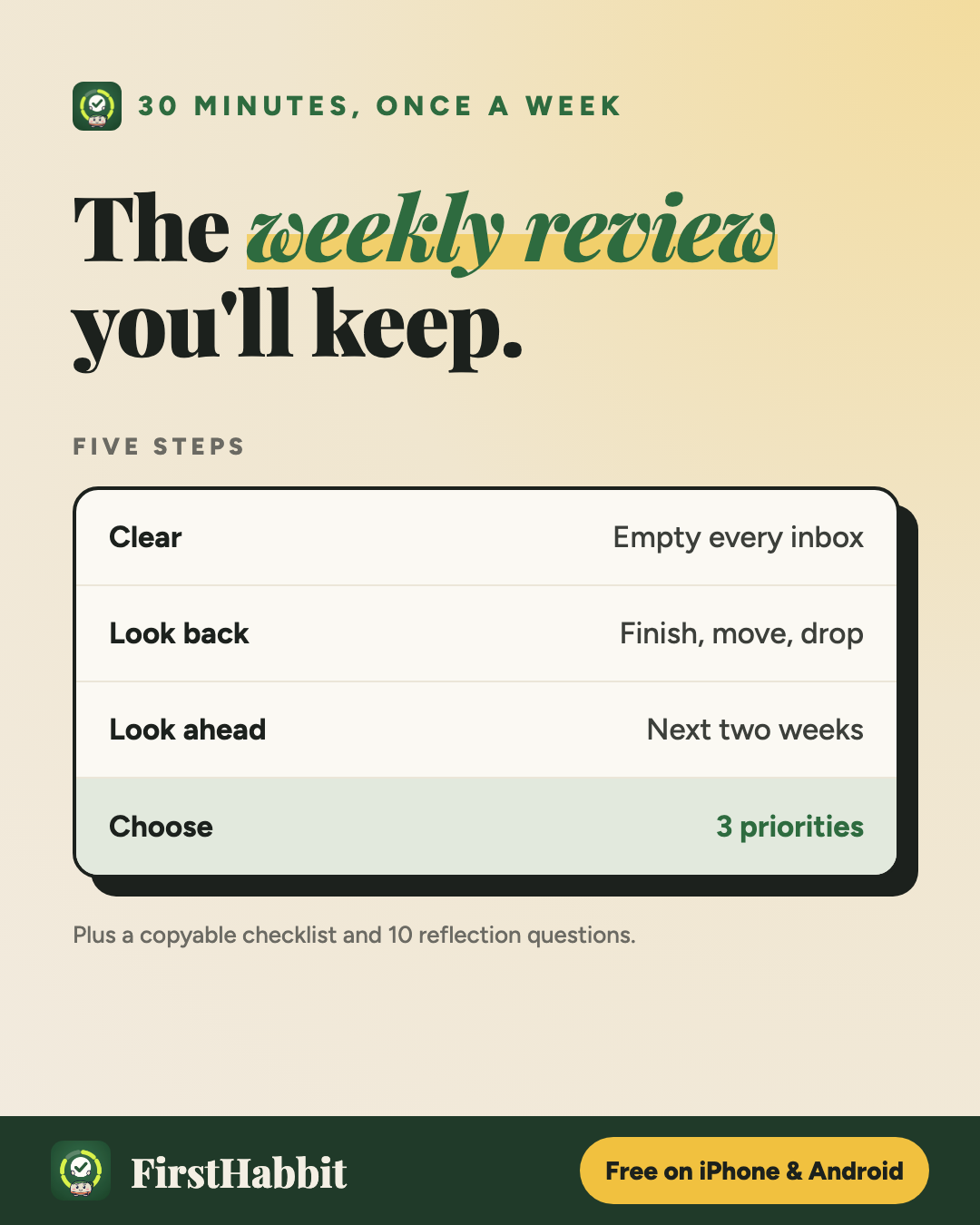
A weekly review is a 30-minute appointment with yourself, once a week, to get back in control. Do it at the same time each week (Friday afternoon or Sunday evening work well) and go through five steps: clear your inboxes and loose notes, look back at last week, check your habits, look ahead at the next two weeks of your calendar, and choose 3 priorities for the coming week. Finish by putting the first task for Monday on your list.
That's it. Below is each step in detail, a checklist you can copy, reflection questions, and the most common reasons weekly reviews get skipped.
Why a weekly review works
Daily planning keeps today on track, but it's too close up to notice drift: a project nobody has touched in three weeks, a habit that quietly stopped, a birthday next Tuesday. A weekly review is the zoomed-out view.
The idea was made popular by David Allen in his book Getting Things Done, where he calls the weekly review the key habit that keeps the whole system trustworthy. His version has three parts: get clear, get current and get creative. The version below follows the same shape, simplified for people who don't run a full GTD system. If you do, our GTD setup guide goes deeper.
There's also a mental benefit. In experiments by Masicampo and Baumeister (2011), unfinished goals kept intruding on people's thoughts, but simply making a specific plan for them reduced that effect. A weekly review is where loose ends get a plan, so they stop nagging at you all weekend.
Before you start
- Pick a fixed slot. Friday 4pm, Sunday 6pm, or Monday 8am before email. Put it in your calendar as a repeating event or routine.
- Have everything in reach: your to-do app or notebook, your calendar, and any place notes pile up (email, messages, paper, photos of whiteboards).
- Set a timer for 30 minutes. A review that takes two hours won't survive the month.
The 5-step weekly review
Step 1: Clear (10 minutes)
Get everything out of your head and out of the places it's scattered.
- Brain dump. Write down anything on your mind: tasks, worries, ideas, things you promised people.
- Empty your inboxes. Process your to-do inbox, paper notes, voice memos and starred emails. For each item: do it now if it takes under two minutes, schedule it, put it on a Someday list, or delete it.
- Clear your desktop and downloads, if digital clutter bothers you.
The goal isn't to do everything. It's to make sure every loose end has a home.
Step 2: Look back (5 minutes)
Open last week's calendar and completed tasks.
- What did you finish? (Take a second to notice it. It's easy to only remember what went wrong.)
- Did anything from last week create a follow-up? A meeting that needs an email, a call that needs a booking.
- What didn't get done? For each: reschedule it, shrink it to a first step, or let it go.
Step 3: Check your habits (5 minutes)
Look at the week's habit tracker or streaks.
- Which habits did you keep? Which slipped?
- For any habit that slipped, ask why (wrong time? too big? forgot?) and change one thing: a new time, a smaller version, a reminder.
- Is anything ready to grow, or is it time to add a new habit? Only add one when the current ones feel easy.
If a streak broke this week, don't start from scratch. Here's how to get back on track after missing a habit.
Step 4: Look ahead (5 minutes)
Open your calendar for the next two weeks.
- Meetings, appointments, deadlines, birthdays, travel. What needs preparing?
- Add prep tasks to the right day ("Print boarding passes" on Thursday, "Buy card" two days before the birthday).
- Spot the busy days and keep them light on tasks.
Step 5: Choose next week's priorities (5 minutes)
- Pick 3 priorities for the week, not 10. One work, one personal and one health or home priority is a good balance.
- Break each into a first step and give it a day.
- Decide Monday's first task so you don't have to think on Monday morning.
Then close the review. Done.
Weekly review checklist (copy and paste)
WEEKLY REVIEW  —  ____ / ____ / ____      (30 minutes)

CLEAR
[ ] Brain dump everything on my mind
[ ] Empty to-do inbox (do / schedule / someday / delete)
[ ] Process notes, voice memos, starred emails, paper

LOOK BACK
[ ] Review last week's calendar and completed tasks
[ ] Add follow-ups from meetings and calls
[ ] Reschedule, shrink or drop unfinished tasks

HABITS
[ ] Check streaks and the habit tracker
[ ] Fix one thing for any habit that slipped

LOOK AHEAD
[ ] Next 2 weeks of calendar: add prep tasks
[ ] Note busy days, keep them light

PRIORITIES
[ ] Next week's top 3:  1. ______  2. ______  3. ______
[ ] First step for each, with a day
[ ] Monday's first task: ______________________
10 weekly reflection questions
Pick two or three each week rather than answering them all:
- What went well this week, and why?
- What drained my energy?
- What did I keep putting off, and what's the real first step?
- Which habit made the biggest difference?
- Did my time match what I said was important?
- What did I say yes to that I should have said no to?
- Who do I need to follow up with?
- What am I worried about, and is there one action I can take?
- What's one thing I learned?
- What would make next week 10% easier?
A Sunday reset version (personal life)
Not everyone needs a work-focused review. A "Sunday reset" adds a few home tasks to the same structure:
- Plan meals and write the shopping list.
- Check the week's family calendar: school events, appointments, who's driving where.
- 15-minute tidy of the kitchen and entry.
- Lay out Monday's clothes and pack bags.
- Check bills and money (a five-minute look at your bank app).
- Then steps 3 to 5 above: habits, look ahead, three priorities.
Why weekly reviews get skipped (and the fix)
- It takes too long. Cap it at 30 minutes. Skip the reflection questions on busy weeks.
- There's no fixed time. "Sometime at the weekend" never happens. Pick a day and time and make it a repeating routine with a reminder.
- It feels like homework. Pair it with something you enjoy: a good coffee, a favourite café, music.
- Inboxes are too full. For the first review, just skim and archive anything older than a month. Next week will be easier.
- You missed one. Do a 10-minute version (steps 4 and 5 only) and pick up next week.
How it fits with daily planning
The weekly review sets direction; a short daily plan turns it into action. Each morning (or the evening before), pick today's 1 to 3 must-dos from the week's priorities. Our 10-minute daily planning routine and to-do list rules cover that part.
How FirstHabbit helps
FirstHabbit is a to-do list and habit tracker that makes each step of the review quick:
- Make the review itself a routine: type "Weekly review every sunday 6pm" and you get a weekly routine with a reminder and a streak.
- Inbox catches everything during the week, so Step 1 is one list, not five apps.
- Upcoming shows the coming days at a glance for Step 4, and Someday holds the ideas you're not ready to commit to.
- Routine streaks and a week of dots show which habits slipped for Step 3.
- Areas and Projects keep work and personal priorities separate.
- Logbook shows what you completed last week for Step 2.
Start free on iPhone or Android with 4 to-dos and 4 habits, plus streaks and reminders. Pro unlocks unlimited everything.
Frequently asked questions
What is a weekly review?
A weekly review is a short, regular session (usually 30 to 60 minutes) where you clear your inboxes, look back at the past week, check your habits and goals, look at the coming weeks, and choose your priorities. It was popularised by David Allen's Getting Things Done method.
What is the best day for a weekly review?
Whichever day you'll stick to. Friday afternoon lets you close the work week; Sunday evening suits personal planning; Monday morning works if weekends are unpredictable. Keep the same slot every week.
How long should a weekly review take?
About 30 minutes. The first one may take longer if your inboxes are full. If it regularly takes over an hour, cut it back to the five core steps.
What questions should I ask in a weekly review?
What went well, what drained my energy, what did I keep putting off, which habit helped most, and what would make next week easier. Two or three questions are plenty each week.
What's the difference between a weekly review and weekly planning?
Weekly planning looks only forward: what you'll do next week. A weekly review also looks back at what happened and clears loose ends first, so the plan is based on reality.
Ready to build better habits?
Download FirstHabbit free: calm to-dos and daily routines with streaks and gentle reminders.
Related Articles

How to Plan Your Day in 10 Minutes: A Simple Daily Planning Routine (2026)
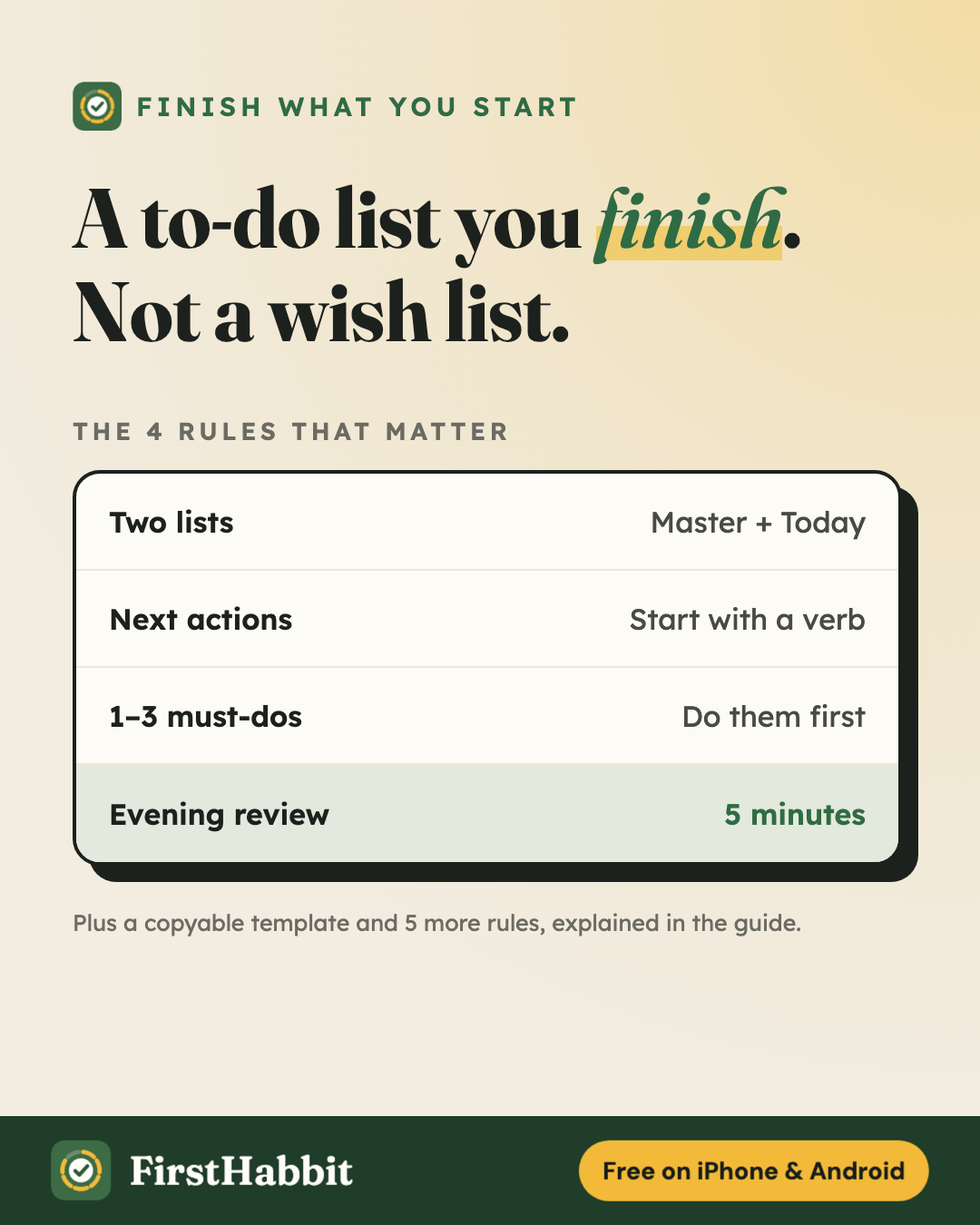
How to Make a To-Do List You'll Actually Finish: 9 Simple Rules (2026)
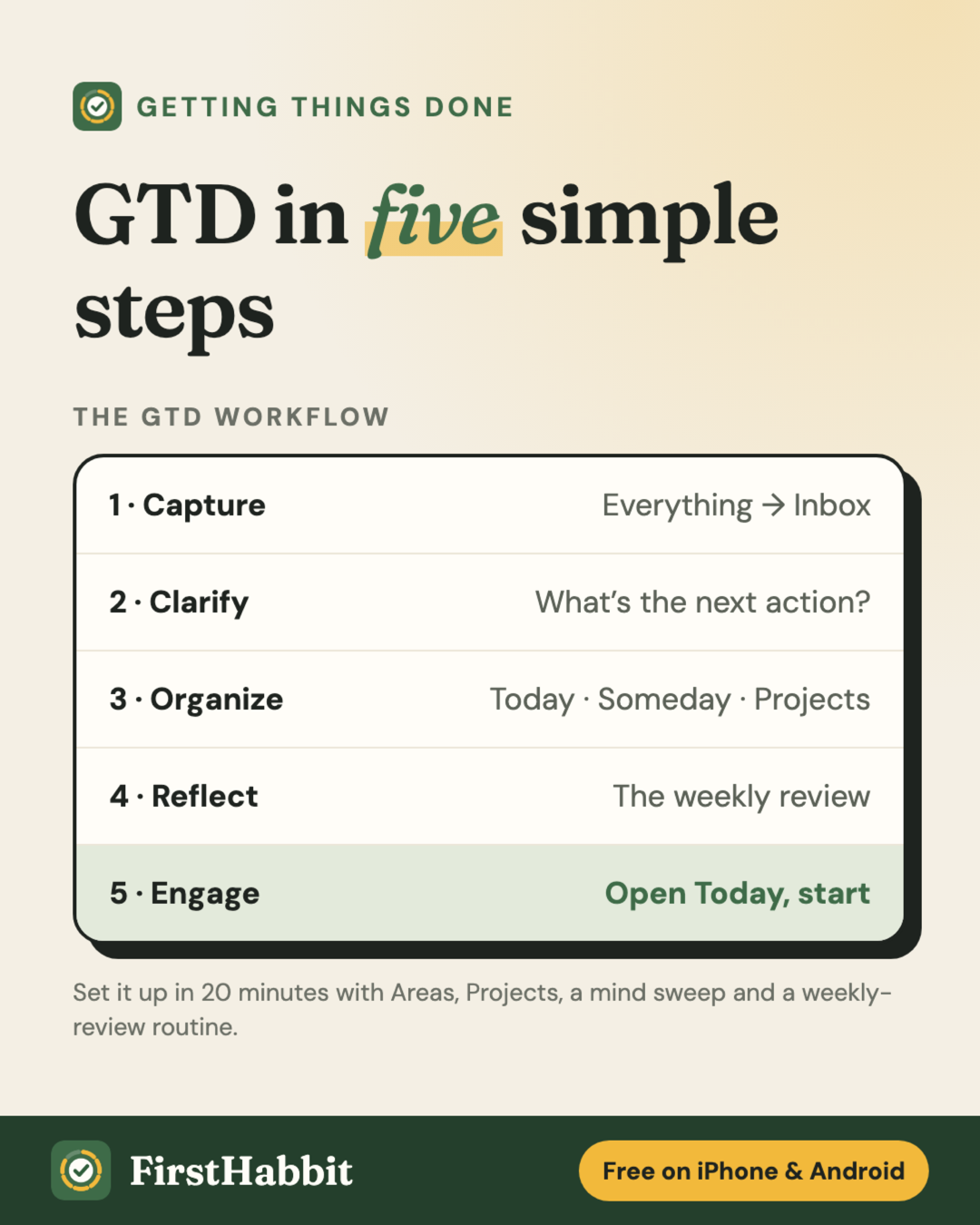
GTD Made Simple: How to Set Up Getting Things Done in One App (2026)