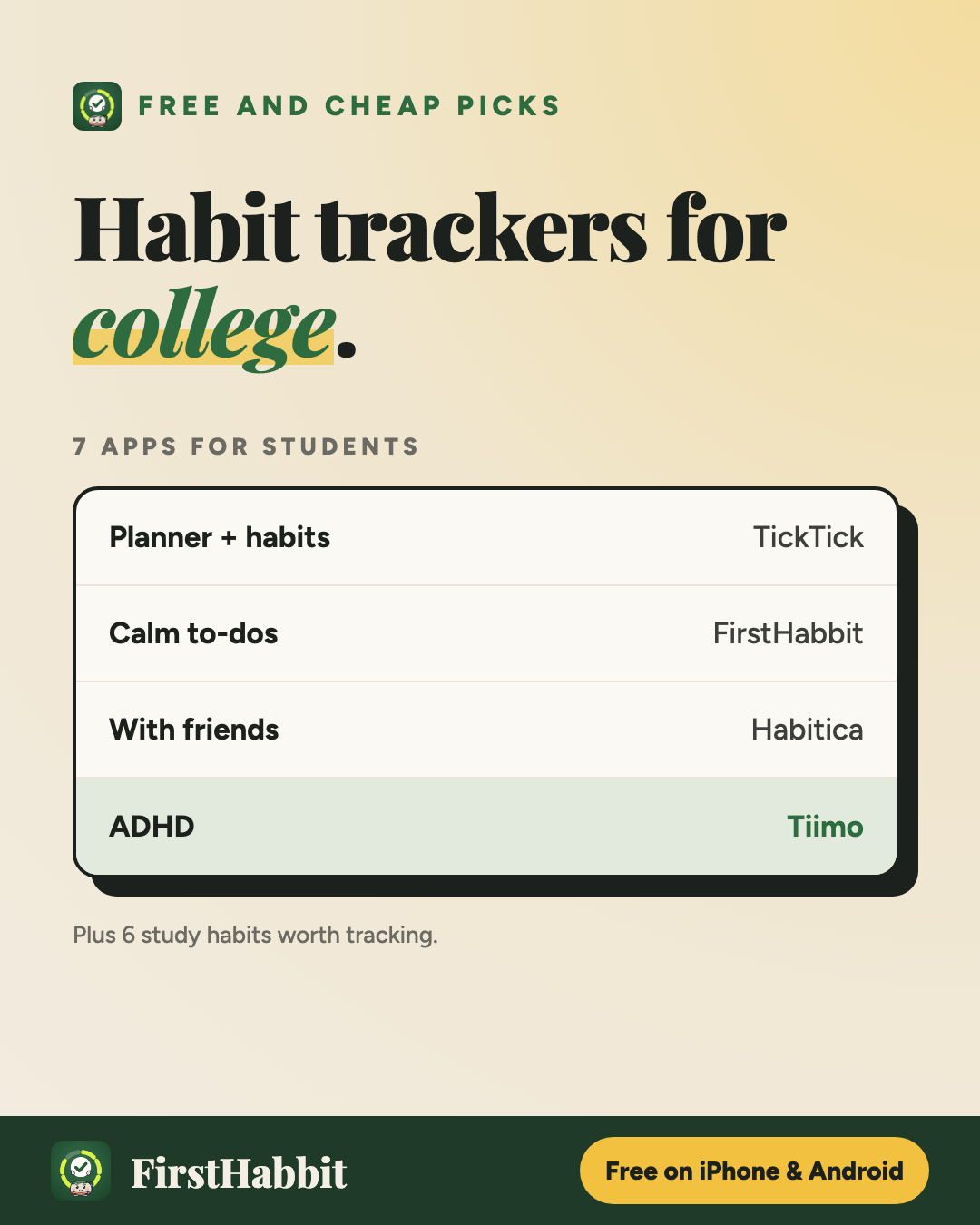
The best habit tracker for college students is free or cheap, works on the phone you already carry, and fits around a timetable that changes every day. Our picks: TickTick for a free planner with habits on your phone and laptop, FirstHabbit (our app) for a calm to-do list with study routines, Habitica for turning habits into a game with friends, Loop for free and simple on Android, HabitShare for accountability with a roommate, Tiimo for ADHD, and Streaks if you're all-Apple and want to pay once.
By Faiz Mohammad, indie developer of FirstHabbit. Disclosure: FirstHabbit is our app. App facts checked on 29 November 2026 against each app's official site, App Store or Google Play page.
Jump to: Comparison table · The 7 apps · What to track · FAQ
What college students need from a habit tracker
Student life is different from a 9-to-5, so the usual "best habit tracker" lists don't quite fit. Look for:
- A free plan that's actually usable. Most students won't pay for a subscription, so the free plan matters more than the paid one.
- Flexible schedules. "Study 3 times a week" or "gym on Monday, Wednesday and Friday" works better than "every day" when your classes change daily.
- Tasks as well as habits. Assignments and exam dates are one-off tasks; reading and review are habits. Having both in one place helps.
- Laptop access if you plan on a computer.
- Forgiving streaks. Exam weeks, travel and illness will break chains. An app that punishes a missed day makes it easier to give up.
Habit trackers for students compared
| App | Best for | Platforms | Free plan | Paid (US) |
|---|---|---|---|---|
| TickTick | Planner + habits, phone and laptop | iPhone, Android, Mac, Windows, web | 5 habits, 9 lists, 99 tasks per list | $49.99/yr |
| FirstHabbit (ours) | Calm to-dos + study routines | iPhone, Android | 4 habits, 4 open to-dos, 1 project, 1 area, small ad | $29.99/yr (7-day trial), $4.99/mo, $69.99 lifetime |
| Habitica | Gamified, with friends | iPhone, Android, web | Core game free | Optional, $4.99/mo |
| Loop Habit Tracker | Free and simple | Android | Everything, no ads | Free |
| HabitShare | Roommate accountability | iPhone, Android | Everything | Free |
| Tiimo | ADHD, visual day plan | iPhone, Android, Mac, web (Pro) | Basic planner, 1 profile | Pro subscription |
| Streaks | All-Apple, pay once | iPhone, iPad, Mac, Watch | None | $5.99 once |
US prices on 29 November 2026. Your country may differ.
The 7 best habit trackers for college students
1. TickTick: best free planner with habits
TickTick is the closest thing to a complete student planner for free. The free plan includes 9 lists, 99 tasks per list and 5 habits, plus a calendar view and a Pomodoro timer, and it syncs between your phone and laptop (Mac, Windows and web). Premium is $49.99/year.
- Good for: students who plan on a laptop and want assignments, a calendar and habits together.
- Watch out for: a busy interface, and habits live in a separate tab from your tasks.
2. FirstHabbit: calm to-dos with study routines (our app)
FirstHabbit puts your routines (habits) and to-dos in one Today list, so "review lecture notes" sits next to "submit lab report Friday". Type tasks in plain English ("Essay draft due fri") and routines ("Read 20 pages every day 9pm"). Streaks have freezes, so one missed day during exams doesn't wipe out your progress.
- Free: 4 routines, 4 open to-dos, 1 project, 1 area and reminders, with a small banner ad. Completing a to-do frees a slot.
- Pro: $29.99/year with a 7-day trial, $4.99/month or $69.99 lifetime, for unlimited everything, widgets and no ads.
- Watch out for: the free plan is small for a full course load, and there's no laptop or web app.
3. Habitica: best for making it a game with friends
Habitica turns habits, dailies and to-dos into a role-playing game. Join a party with classmates, and missed dailies hurt the whole party, which is real peer pressure. The core game is free on iPhone, Android and the web; a subscription is optional ($4.99/month on the US App Store).
- Good for: students who like games and have friends to play with.
- Watch out for: the game can become a distraction, and Google Play lists the app as containing ads.
4. Loop Habit Tracker: best free option on Android
Loop is free, open source and has no ads or account. Its habit-strength score rewards consistency rather than perfect streaks, which suits unpredictable student weeks.
- Good for: Android users who just want to track a few habits.
- Watch out for: no iPhone version, no tasks, and the last update was September 2025.
5. HabitShare: best for roommate or study-buddy accountability
HabitShare is 100% free on iPhone and Android. Share chosen habits with chosen friends, so a study partner can see whether you actually did your two hours in the library.
- Good for: accountability across different phones.
- Watch out for: basic stats, and the iPhone app was last updated in January 2023.
6. Tiimo: best for students with ADHD
Tiimo shows your day as a colour-coded visual timeline, with a focus timer and an AI co-planner that breaks big tasks into steps. It says it was co-designed with ADHD and autism experts. The free version includes a basic planner and 1 profile; Pro (with a 7-day trial on the yearly plan) adds more, including the web app.
- Good for: visual planners and neurodivergent students.
- Watch out for: it's a planner first, with lighter habit tracking. See also our ADHD to-do list guide.
7. Streaks: best for all-Apple students who hate subscriptions
$5.99 once, no subscription, no ads, a full Apple Watch app and Apple Health automation. It tracks up to 24 habits a day.
- Good for: iPhone and Apple Watch users who want to pay once.
- Watch out for: Apple-only, no tasks, no free plan. Full details in our Streaks app review.
6 habits worth tracking in college
These are habits with good evidence behind them for learning and wellbeing. Track two or three, not all six.
- Self-test after each lecture (5 to 10 minutes of recall questions). Practice testing was one of two techniques rated "high utility" in a large review of study methods by Dunlosky and colleagues (2013).
- Spaced review of older material, a few times a week. Spreading practice out (distributed practice), the other "high utility" technique, beats cramming the same hours into one night.
- A fixed study block at the same time and place each day. A consistent cue makes a habit easier to start.
- A regular sleep window. The American Academy of Sleep Medicine recommends adults get 7 or more hours a night.
- Plan tomorrow's top three tasks before bed. See how to plan your day.
- A short weekly review on Sunday: check deadlines for the next two weeks. See the weekly review checklist.
For a full 4-week plan built around these, read study habits that improve grades.
How to set up a habit tracker for a semester
- Pick one app from the list based on your phone and whether you plan on a laptop.
- Add 2 or 3 habits from the list above, each with a specific time ("after my last class", "9pm at my desk").
- Add this week's deadlines as tasks (if your app has tasks), plus the big exam dates.
- Set schedules that match your timetable, such as weekdays only, or 3 times a week.
- Expect misses. In Lally and colleagues' 2010 study, a new daily habit took a median of 66 days to become automatic, and missing a single day didn't materially affect the outcome. Keep going rather than starting over. More in why the 21-day rule is a myth.
Comparing more apps? See our best habit tracker apps 2026 (15 apps) and best free habit tracker apps.
Frequently asked questions
What is the best habit tracker for college students?
For most students, TickTick, because its free plan includes tasks, a calendar and 5 habits on both phone and laptop. Choose FirstHabbit for a calmer to-do list with study routines on iPhone or Android, Habitica to make it a game with friends, or Loop for free and simple on Android.
Is there a free habit tracker for students?
Yes. Loop Habit Tracker (Android) and HabitShare (iPhone and Android) are completely free. TickTick (5 habits), FirstHabbit (4 habits and 4 to-dos) and Habitica (core game) have free plans.
What habits should a college student track?
Two or three at first: self-testing after lectures, spaced review, a fixed study block, a regular sleep window, planning tomorrow's top three tasks, or a weekly review of deadlines.
Should students use a habit tracker or a planner?
Ideally both in one: a planner for one-off tasks like assignments and exams, and a habit tracker for repeating behaviours like review sessions. TickTick and FirstHabbit combine the two; Habitica does too, as a game.
What's the best habit tracker for students with ADHD?
Tiimo, a visual planner co-designed with ADHD and autism experts. A short daily list with two or three forgiving habits also works well; see our ADHD to-do list guide.
Related: Best habit tracker apps 2026 · Study habits that improve grades · Best free habit tracker apps · ADHD to-do list
Ready to build better habits?
Download FirstHabbit free: calm to-dos and daily routines with streaks and gentle reminders.
Related Articles
Best Habit Tracker Apps 2026: 15 Apps Reviewed and Compared

Study Habits That Improve Grades: A Habit-Tracking Plan for Students

Best Free Habit Tracker Apps 2026: 9 Apps With No Subscription Needed