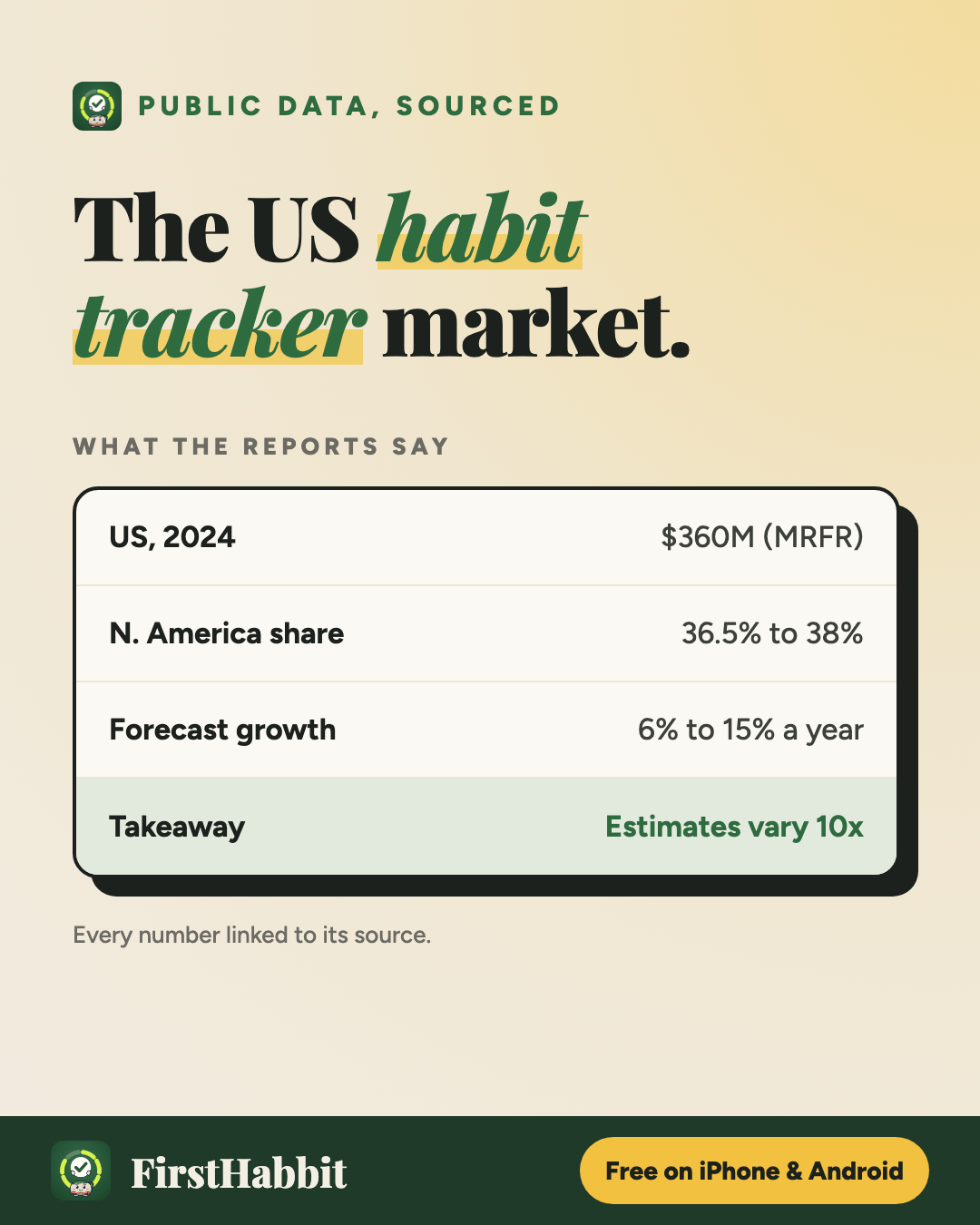
How big is the US habit tracker app market? The only US-specific public estimate we could find, from Market Research Future, puts it at $360 million in 2024, growing to about $677 million by 2035. Other firms only publish North America or global figures, and their estimates for the same market differ by up to roughly 10x. Treat every number below as a vendor estimate, not a measured fact.
By Faiz Mohammad, indie developer of FirstHabbit, a to-do and habit app. Every figure on this page links to its source and was read on 29 November 2026. We only quote numbers visible on the public pages; we haven't bought the full reports.
Jump to: The estimates · Why they disagree · How apps make money · What it means · FAQ
Public estimates, side by side
| Source | Scope | Figure | Forecast | Page date |
|---|---|---|---|---|
| Market Research Future | United States | $360.0M (2024), $384M (2025) | $676.8M by 2035, CAGR 5.91% | Updated 15 Sep 2026 |
| DataHorizzon Research | North America | $183.2M (2024) | $647.9M by 2033 | Published 20 Feb 2025 |
| DataHorizzon Research | Global | $512.3M (2024) | about $1.22B by 2033, CAGR 14.8% | Published 20 Feb 2025 |
| Straits Research | Global | $1.94B (2025), $2.22B (2026) | $6.41B by 2034, CAGR 14.2%; North America 36.5% share (2025) | Updated 28 Oct 2026 |
| Verified Market Research | Global | $1.70B (2025) | $5.20B by 2033, CAGR 13.1%; North America about 38% | Updated May 2026 |
Two warnings from the pages themselves:
- The Market Research Future page also shows a much larger figure ($5.43 billion in 2024, rising to $20.76 billion by 2034) alongside the $360 million US figure. The two can't both describe the same US market, so we quote the US-labelled number and flag the conflict.
- DataHorizzon's regional figures don't add up neatly to its own global total.
A rough US range
If you apply Straits' and Verified Market Research's North America shares (36.5% and about 38%) to their global 2025 figures, North America lands somewhere around $0.6 to $0.7 billion in 2025. That's our arithmetic on their numbers, and it includes Canada. Compare it with Market Research Future's $384 million for the US alone in 2025 and DataHorizzon's $183 million for North America in 2024, and you can see the spread: depending on whose definition you use, the US market is somewhere between a few hundred million dollars and well under a billion.
Why the estimates disagree so much
- Different definitions. "Habit tracker" can mean only dedicated habit apps (Streaks, Loop, Habitify) or a wider set that includes coaching apps, wellness apps with habit features and to-do apps with habit tabs. A wider definition gives a far bigger number.
- Different revenue counted. Some reports count only in-app subscription revenue; others appear to include advertising, enterprise wellness deals or hardware-linked services.
- Little public data. Most habit apps are private companies or solo developers who don't publish revenue. Estimates are built from app-store download and revenue estimates, surveys and models.
- Different base years and growth assumptions. A 6% compound growth rate and a 15% one produce very different 2033 numbers from the same starting point.
The honest takeaway: the market is real and growing in every estimate, but no public source measures the US habit tracker market precisely. Be wary of any article that quotes a single figure without its source.
Where habit trackers live on the App Store
Apple doesn't have a "habit tracker" category. Developers choose a primary and secondary category from Apple's list, and the primary category decides where the app appears when people browse. Habit trackers usually pick one of two, per Apple's category definitions:
- Health & Fitness: "Apps related to healthy living, including stress management, fitness, and recreational activities."
- Productivity: "Apps that make a specific process or task more organized or efficient", with task management as an example.
This split is one reason the market is hard to size: the same kind of app can sit in either category, and charts and reports count them differently.
How habit tracker apps make money in 2026
Looking at the official store listings of 15 popular habit trackers (checked 29 November 2026; details in our best habit tracker apps 2026 comparison), four business models show up:
| Model | Examples (US prices) |
|---|---|
| Subscription with a free tier | TickTick ($49.99/yr, 5 free habits), Atoms ($39.99/yr), EasyHabits ($19.99/yr, 3 free habits), Habitify (3 free habits) |
| Subscription plus lifetime option | Habitify ($59.99 lifetime), FirstHabbit ($29.99/yr, $4.99/mo or $69.99 lifetime; 4 free habits and 4 to-dos) |
| One-time purchase | Streaks ($5.99), HabitNow (one-time premium on Android) |
| Completely free | Loop Habit Tracker (open source), HabitShare |
A few patterns stand out:
- Freemium subscriptions dominate. Most apps let you start free with a small limit (often 2 to 5 habits) and charge yearly for more.
- Lifetime plans are common again, as people push back against subscription fatigue.
- Free, ad-free options still exist, mostly from open-source or hobby developers, and they're often the highest rated.
- Ads are rare. Of the apps we checked, Google Play marked only Habitica as containing ads; FirstHabbit's free plan also shows a small banner ad.
How to read a market report summary
Most "habit tracker market" pages are free summaries of paid reports. Before you quote one:
- Find the scope. Is it the US, North America or global? Many articles quote a global number as if it were the US.
- Find the base year. A 2024 figure and a 2025 figure from different firms aren't directly comparable.
- Check the definition. Does it include wellness, coaching or to-do apps with habit features?
- Look for contradictions on the page. As noted above, at least one summary shows two incompatible figures.
- Prefer ranges to single numbers. Given how far the estimates diverge, "a few hundred million dollars in the US" is more honest than any single figure.
What this means if you're choosing an app
Market size doesn't tell you which app to use, but the business model does:
- If you hate subscriptions, look at Streaks (iPhone, $5.99 once), HabitNow (Android, one-time upgrade) or a lifetime plan.
- If you want free forever, Loop (Android) and HabitShare (both phones) don't charge at all.
- If you'll pay yearly, compare what the free plan includes first, because that's where you'll find out whether you like the app. See the best free habit tracker apps.
- Check the last update date. In a crowded market, some apps quietly stop being maintained.
Frequently asked questions
How big is the US habit tracker app market?
Market Research Future estimates the US habit tracker app market at $360 million in 2024 and $384 million in 2025, rising to about $677 million by 2035. Other firms publish only North America or global figures, and estimates vary widely, so treat any single number as an estimate.
How big is the global habit tracking app market?
Public estimates range from about $512 million in 2024 (DataHorizzon Research) to $1.70 billion (Verified Market Research) and $1.94 billion (Straits Research) in 2025. The gap comes mostly from different definitions of what counts as a habit tracking app.
How fast is the habit tracker app market growing?
Forecast compound annual growth rates range from about 6% (Market Research Future, US) to about 13% to 15% (global estimates from Verified Market Research, Straits Research and DataHorizzon Research).
What share of the habit tracker market is North America?
Straits Research puts North America at 36.5% of the global market in 2025, and Verified Market Research at about 38%.
How do habit tracker apps make money?
Mostly through freemium subscriptions: a free plan with a habit limit and a yearly plan for unlimited use. Some sell a one-time purchase (Streaks) or a lifetime plan, a few show ads, and some are completely free.
Sources
All read on 29 November 2026:
- Market Research Future, US Habit Tracker App Market (page updated 15 September 2026)
- DataHorizzon Research, Habit Tracking Apps Market (published 20 February 2025)
- Straits Research, Habit Tracking Apps Market (updated 28 October 2026)
- Verified Market Research, Habit Tracker Apps Market (updated May 2026)
- Apple, App Store categories and discoverability
- App prices and free limits: each app's official website, US App Store listing or Google Play listing, as linked from our best habit tracker apps 2026 comparison
Related: Best habit tracker apps 2026 · Best free habit tracker apps · Streaks app review · To-do list and habit tracker in one app
Ready to build better habits?
Download FirstHabbit free: calm to-dos and daily routines with streaks and gentle reminders.
Related Articles
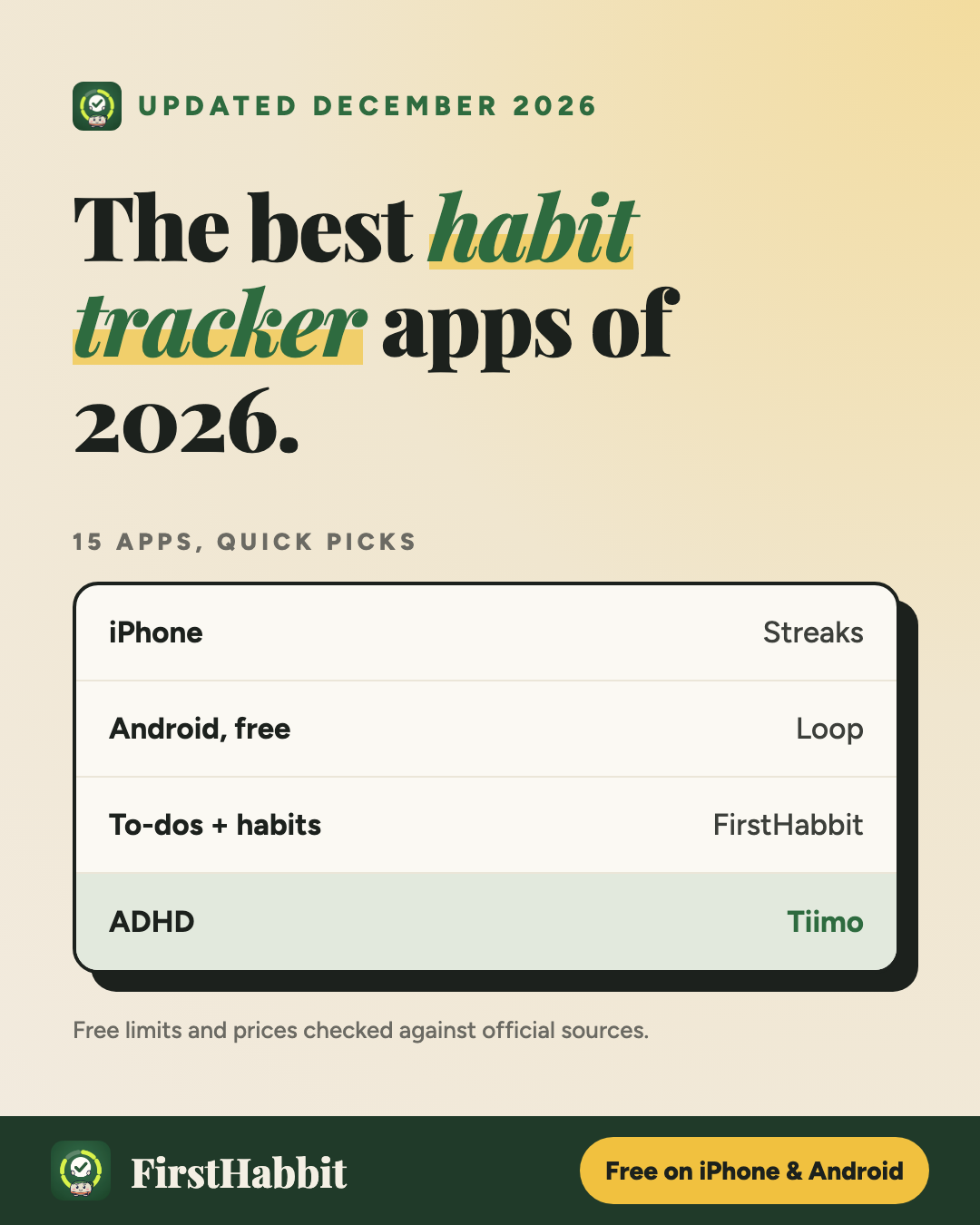
Best Habit Tracker Apps 2026: 15 Apps Reviewed and Compared

Best Free Habit Tracker Apps 2026: 9 Apps With No Subscription Needed
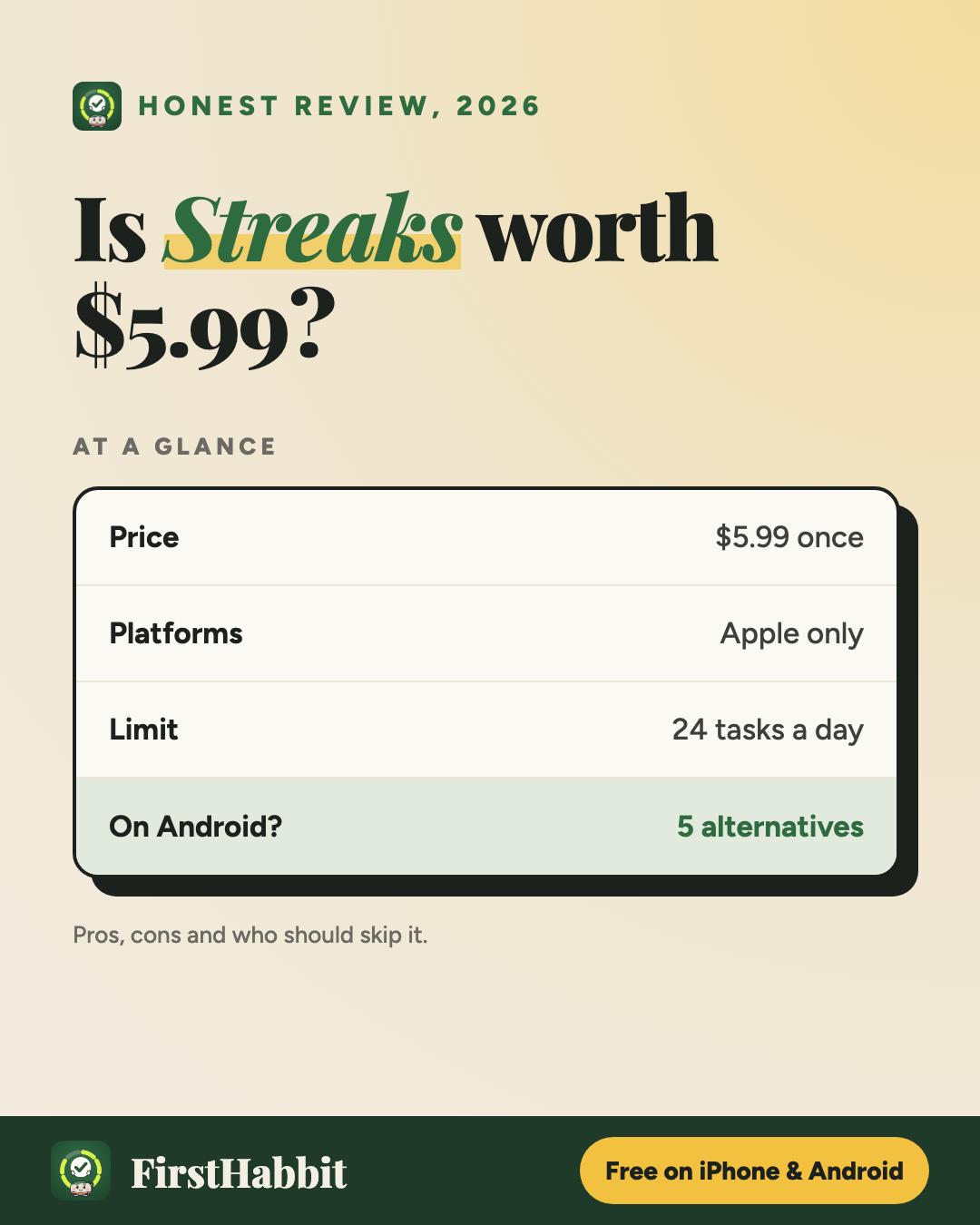
Streaks App Review (2026): Worth $5.99? Pros, Cons and Android Alternatives